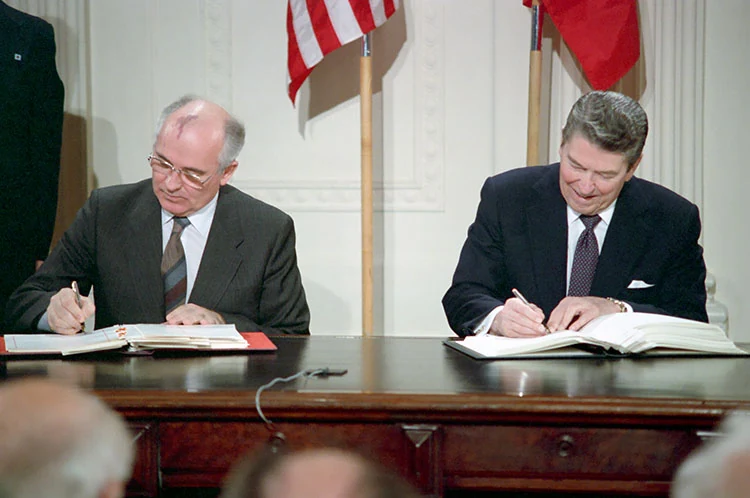
President Ronald Reagan and Soviet General Secretary Mikhail Gorbachev sign the INF Treaty in the White House East Room, December 8, 1987. Signing photograph; subsequent ratification, implementation and withdrawal are separate in the record.
The photograph belongs to the White House Photographic Office collection. The gallery does not name an individual photographer or provide an item-specific copyright declaration; National Archives custody alone does not establish copyright status.
Presented as historical editorial illustration. Library guidance restricts uses of identifiable likenesses for advertising, selling or solicitation without consent. No endorsement is implied.
The photograph documents signing; ratification, implementation and later withdrawal from the treaty are separate questions.
Context & scope
Reagan-era agreement; Soviet participation, U.S.–Soviet ratification, and George H. W. Bush-era implementation all contributed. Historically implemented; treaty lapsed August 2, 2019. It must not be presented as a currently operating treaty.
Goal
Eliminate specified U.S. and Soviet ground-launched missiles of intermediate and shorter range and verify the reductions.
The covered missile systems were eliminated by May 1991. CRS reports the Soviet Union destroyed 1,846 missiles and the United States 846. Final elimination occurred under George H. W. Bush after Reagan’s presidency.
The ban covered land-based missiles with ranges of 500–5,500 km, not sea- or air-delivered missiles; warheads and guidance systems were not required to be destroyed. Verification and later compliance disputes limited durability. The United States implemented withdrawal and the treaty lapsed on August 2, 2019.
Congressional Research Service (CRS), Library of Congress
Source date
2020-03-26
Document type
official government retrospective research
Reading location
The Early Years: SALT I and SALT II, printed p.5 ; Interim Agreement on Offensive Arms, printed p.5 ; Interim Agreement on Offensive Arms, printed p.6 ; The ABM Treaty, printed p.7 ; Ballistic Missile Defenses and the ABM Treaty, printed p.15 ; The Intermediate-Range Nuclear Forces Treaty, printed pp.7–8