Harry S. Truman / Truman / Alliances & security

Creation of NATO

1949

Treaty approved · alliance established (1949)

Historical case snapshot · reviewed

Published · Visual edition October 6, 2026

Compare this case
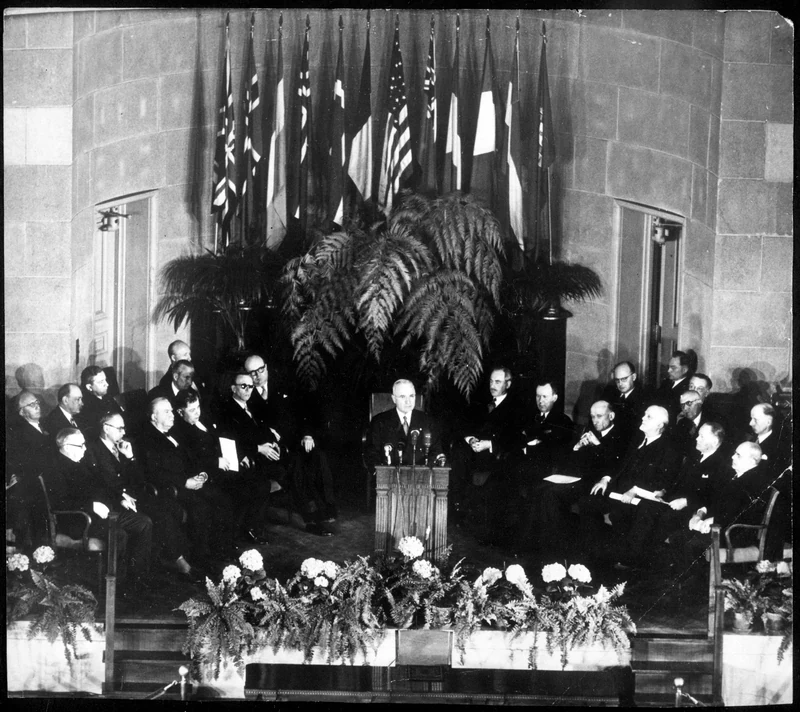
Harry S. Truman speaks at a podium with the foreign ministers of the NATO signatory nations seated behind him.

DOCUMENTARY EVENT PHOTOGRAPH

President Harry S. Truman addresses the North Atlantic Treaty signing ceremony, April 4, 1949, at the State Department Auditorium in Washington, D.C. Archival event photograph; not evidence of later treaty implementation.

Photo source & use notes

Date: Photographed April 4, 1949

Place: State Department Auditorium, Washington, D.C.

New York Times Paris Bureau / Harry S. Truman Presidential Library and Museum, National Archives (306-NT-355C-24) (opens in a new tab)

Public Domain — exact official archival item designation (opens in a new tab)

The archive marks this exact item Public Domain and credits the New York Times Paris Bureau. An individual photographer is not named.

The archive places responsibility for attribution and rights assessment on users. This ceremony photograph does not establish later treaty implementation.

Context & scope

A presidential-era record involving the Senate, Canada, and European founding members; not exclusive presidential causation. Historical alliance established; outcome verification refers to 1949, with institutional context from the March 2019 CRS vintage.

Goal

Create a transatlantic collective-defense framework to deter Soviet expansion and coordinate the defense of North America and Western Europe.

Action

The United States was a driving proponent of NATO’s creation; the Senate approved the treaty and the United States entered NATO in 1949.

Established result

A 12-member collective-defense alliance was established. Senate approval on July 21 and U.S. membership on August 24 are distinct from NATO’s April 4 founding date.

Cost / open questions

Membership created continuing defense commitments. Article 5 leaves each ally to choose the action it deems necessary; subsequent military presence, defense spending, and burden-sharing remained contested. This institutional outcome does not establish that Truman alone caused later peace.

OFFICIAL EVIDENCE / FULL SOURCE REGISTER

Open the sources.

Source dates identify the original publication, document or stated vintage. The review date identifies when this edition examined that evidence.

Assessing NATO's Value (opens in a new tab)

Agency
Congressional Research Service (CRS), Library of Congress
Source date
2019-03-28
Document type
official government retrospective research
Reading location
Historical Context / The Cold War ; Summary; 29 is report-vintage context, not current membership ; Article 5 text box ; Summary; these costs are attributed to critics rather than treated as measured policy effects
Reviewed