More training capacity.
The Army reported ten additional basic-training units and capacity for up to 9,600 additional recruits annually, supported by Army Reserve drill sergeants. Capacity is not a count of completed training.
Official source ↗TRUMP II / MILITARY RECRUITING
Five services met their FY2025 recruiting quantity goals. Read the results alongside the earlier recovery, changing targets and the next year’s contract milestones.
01 / THE PUBLISHED RESULT
Active-component enlisted recruits with no prior military service. These are recorded accessions into service, distinct from signed contracts or the size of the entire force.
Each bar starts at zero and uses the same 0–120% scale. The marker is 100% of that service’s own target; bar length is not a comparison of absolute recruit numbers. Percentages are calculated from the published counts and rounded to one decimal.
Official source ↗This table excludes officers, prior-service entrants, Reserve and National Guard components, and the Coast Guard. Reaching the listed goals does not establish that every component met every recruiting or readiness standard.
02 / THE INHERITED CONTEXT
Four of these five services met their FY2024 quantity goals; the Navy remained below its accession target. The Army’s FY2025 increase builds on a FY2024 recovery. Compare both the numerator and the target.
| Service | FY2024 goal | FY2024 accessions | FY2025 goal | FY2025 accessions |
|---|---|---|---|---|
| Army | 55,000 | 55,150 | 61,000 | 62,050 |
| Navy | 40,600 | 35,804 | 40,600 | 44,096 |
| Marine Corps | 27,500 | 27,500 | 26,600 | 26,600 |
| Air Force | 27,200 | 27,303 | 30,100 | 30,166 |
| Space Force | 704 | 716 | 796 | 819 |
CRS explains that quantity goals depend on authorized force size and expected retention, and may change during a year. A higher attainment percentage can reflect a different target as well as a different number of recruits. Official source ↗
Biden administration.
Spans Biden and Trump II; Trump took office January 20, 2025.
Annual accessions do not isolate the effect of a president, one policy or a particular month. Recruiting staff, prior contracts, training capacity, incentives, retention and Congress all shape the result.
03 / THE IMPLEMENTATION
The Army reported ten additional basic-training units and capacity for up to 9,600 additional recruits annually, supported by Army Reserve drill sergeants. Capacity is not a count of completed training.
Official source ↗The Army announced signed contracts with more than 61,000 future Soldiers, four months before the fiscal year ended. The later CRS table separately records 62,050 FY2025 accessions.
Official source ↗The Army announced signed contracts with more than 61,500 future Soldiers. This is a dated contract milestone; this edition does not present it as a completed FY2026 accession total.
Official source ↗04 / THE QUALITY CHECK
Share in the above-average test categories.
DoD benchmark: 60%.
CRS reports that the Army missed this separate aptitude benchmark in FY2025, while all five services met the high-school-diploma benchmark. Those measures belong beside the headcount result.
A service-wide benchmark is distinct from an individual’s eligibility to enlist. These statistics alone do not establish combat readiness, recruit retention or the cost of achieving the targets.
Official source ↗READ THE ORIGINALS
Reviewed September 30, 2026. FY2025 counts use the fixed January 20, 2026 CRS edition. Later contract announcements retain their own dates and measures.
The appearance of U.S. Department of War (DoW) visual information does not imply or constitute DoW endorsement.
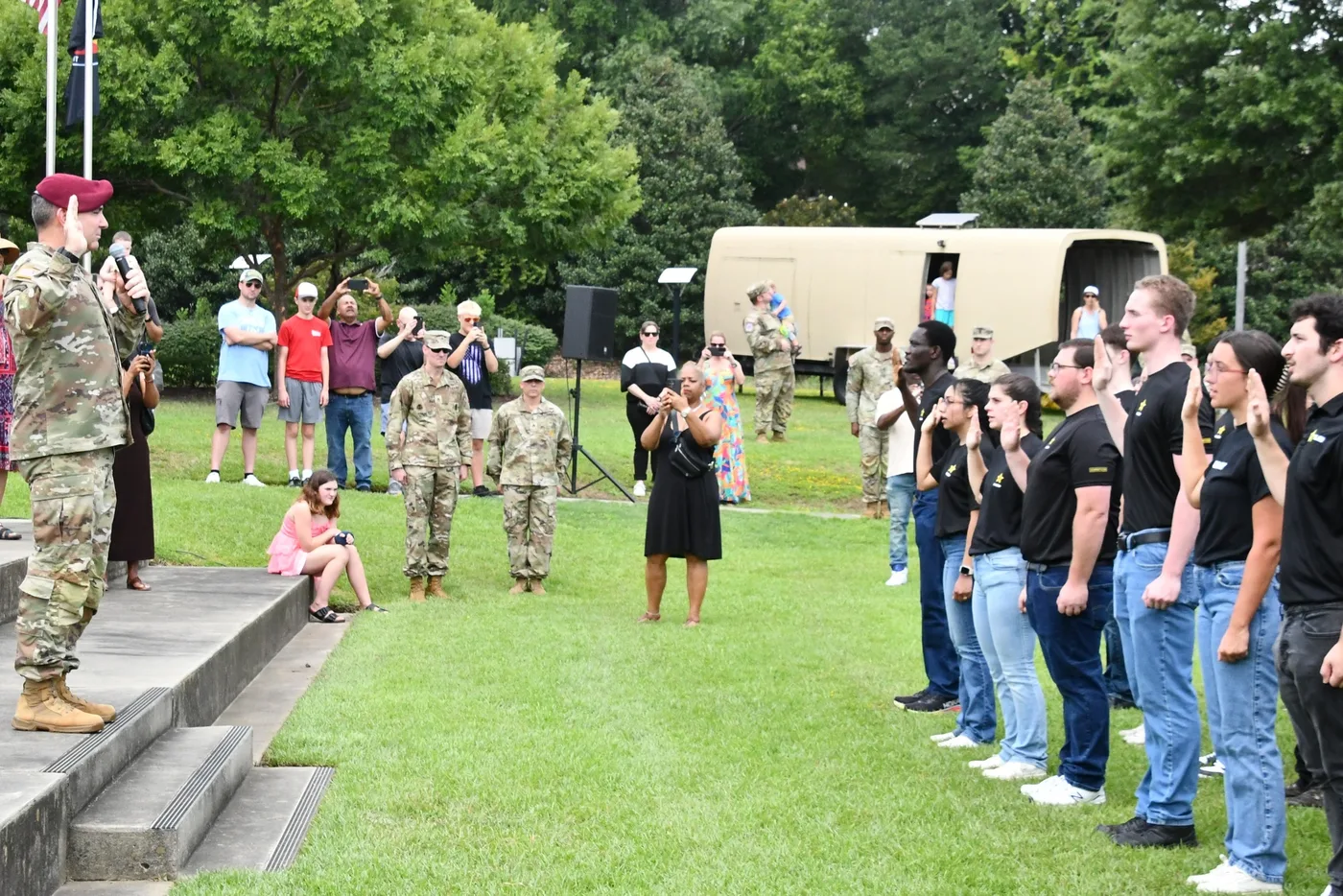
DVIDS marks the photograph as public domain. It is resized and compressed without changing its content. The ceremony illustrates enlistment; the image does not establish the annual totals or presidential causation. Media-use conditions ↗