George W. Bush I / 2001–2004
Start with 2000.
- First calendar-year GDP change
- +1.0%2000 annual level → 2001 annual level
- Unemployment baseline → endpoint
- 3.9% → 5.4%December 2000 → December 2004
 POTUSRECORDThe office changes.
PRESIDENT OVERVIEW / SELECTED EVIDENCE
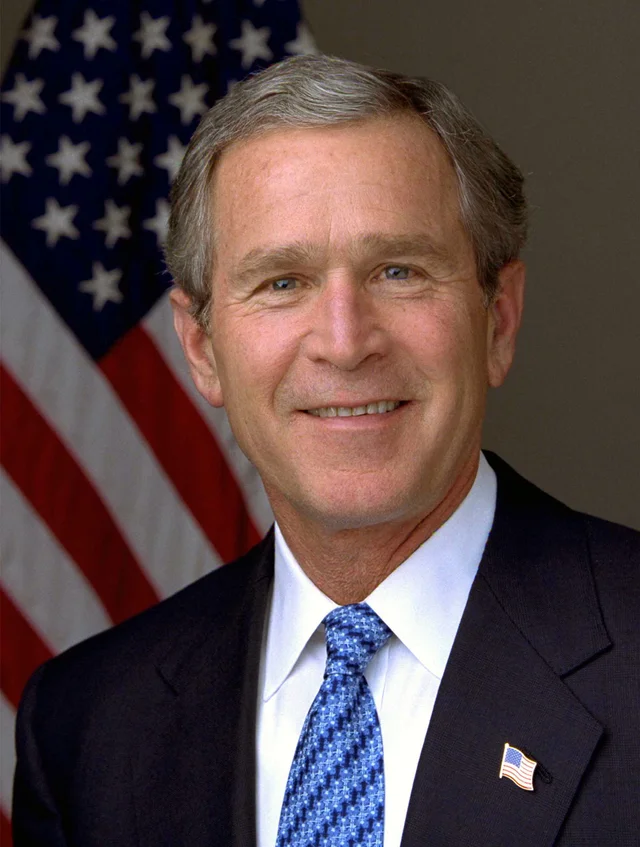
43rd president of the United States · Republican · 2001–2009
By POTUS RECORD · Published .
01 / 2 COMPLETED ECONOMIC TERMS
Each term covers four calendar years, including the January handover. The lines below place each term among all 12 completed windows from 1977 to 2024; they show position on one measure, not an overall score.
| Measure | George W. Bush I2001–2004 | George W. Bush II2005–2008 |
|---|---|---|
| Average annual real GDP growthArithmetic mean of four annual growth rates | 2.3% | 2.1% |
| Average annual inflationFour annual changes in annual-average CPI-U | 2.3% | 3.3% |
| Average unemployment rateMean of 48 monthly U-3 rates | 5.5% | 5.0% |
| Cumulative real GDP changePrior annual level → final annual level | +9.6% | +8.6% |
| Cumulative consumer price changePrior December → final December | +9.4% | +10.5% |
| Unemployment rate change (percentage points)Prior December → final December | +1.5 | +1.9 |
George W. Bush I / 2001–2004
George W. Bush II / 2005–2008
The inherited baselines are annual or December observations, not inauguration-day measurements. Recessions, recoveries, the Federal Reserve, Congress, inherited policies and global events affect these outcomes. These windows do not isolate a president’s causal contribution.
GDP and CPI changes are cumulative, not annualized. U-3 measures the unemployed share of the labor force; it does not alone describe employment or participation.
Archived data edition v1 · Full comparison coverage: 1977–2024.
02 / DIPLOMACY & SECURITY
Selected case studies from the diplomacy comparison. Each case keeps its own historical window and review date; together they are not a total of diplomatic success.
2000–2008 · inherited program
Programs implemented · mixed goals assessed by GAO (2008)
Inherited and historical context. Colombia initiated its plan in 1999. Initial U.S. funding was approved under Clinton in July 2000; many programs became operational under George W. Bush in 2001 and later. The evidence spans both administrations.
Underlying source review: .
Read the full case2004–2006
Screening procedures implemented · compliance gaps documented
Inherited and historical context. Institutional implementation reviewed in GAO reports issued July 2005 and July 2006; this is an oversight case, not a finding of democratic transition.
Underlying source review: .
Read the full case2007–2008 · dated oversight
Measured attacks declined · broader institutions incomplete
Inherited and historical context. The Iraq war began in 2003. This case reviews the 2007 strategy and 2008 oversight, rather than the whole war. Changes involved U.S. and Iraqi actors and a militia cease-fire; they are not assigned solely to the president.
Underlying source review: .
Read the full case03 / MILITARY OPERATIONS
Operation records follow official operation dates. Operations that span administrations are shown with every president they cover and are not assigned wholly to one.
October 7, 2001 – December 31, 2014
Presidents covered. George W. Bush → Obama
The OEF combat phase, not the entire Afghanistan war ending in 2021. OEF casualty totals include locations outside Afghanistan. Freedom’s Sentinel is excluded.
March 20, 2003 – September 1, 2010
Presidents covered. George W. Bush → Obama
Dates follow the DCAS operation chronology; September 1 marks the transition to New Dawn. This compares Operation Iraqi Freedom, not every phase of U.S. involvement in Iraq. New Dawn and later operations are excluded.
04 / MIDTERM ELECTIONS
House change counts the president’s party seats in the initial-election divisions before and after the midterm, from the reviewed 1934–2022 edition.
| Midterm | House seats | House control | Senate control |
|---|---|---|---|
| 2002First term | +8 | Retained majority | Gained majority |
| 2006Second term | −30 | Lost majority | Lost majority |
05 / SOURCES & COVERAGE LIMITS
This is a selected reading across existing collections, not a complete biography or an audit of the presidency. Each record keeps its original review date; November 3, 2026 is this page’s editorial date, not a fresh review of every source. The number of included records measures coverage, not success.
U.S. Government Accountability Office
Official oversight report · Published October 6, 2008 · Reviewed October 6, 2026
Read: Relevant report pages: 1, 1 footnote 1, 17, 2, 2 footnote 6, 5, 4, 18, 7
U.S. Congress; U.S. Government Publishing Office / GovInfo
Original statute / reorganization plan · Published July 13, 2000 · Reviewed October 6, 2026
Read: Relevant report pages: 114 Stat. 573
U.S. Government Accountability Office (GAO)
Official oversight report · Published July 29, 2005 · Reviewed October 6, 2026
Read: p. 3
U.S. Government Accountability Office (GAO)
Official oversight report · Published July 31, 2006 · Reviewed October 6, 2026
Read: p. 2, footnote 2; p. 21; p. 26; p. 33; p. 3; p. 3, footnote 5
U.S. Government Accountability Office
Official oversight report · Published June 23, 2008 · Reviewed October 6, 2026
Read: Relevant report pages: 1, 18, 3, 14, 16, 44
U.S. Government Accountability Office
Official oversight report · Published January 9, 2007 · Reviewed October 6, 2026
Read: Relevant report pages: 13, 1
Editorial synthesis by POTUS RECORD · Report a correction with the page and official source.