
PRESIDENTS / DIPLOMACY & SECURITY

Different presidents.
The same questions.

Choose two dated cases. Compare the goal, action, documented result, durability, human and fiscal costs, and unresolved evidence. Follow every answer to the official record.

Published · Comparison guide updated October 25, 2026; source review dates unchanged

12 presidents 29 selected cases 13 administrations

Browse every evidence record ↓
Explore the historical balance of power ↓

THE SELECTED QUESTION

Alliances & security cooperation

What did partners agree to, what took effect, and what capability followed?

4 presidents · 5 selected cases in this theme

READ THE SAME QUESTION ACROSS BOTH CASES

The evidence, side by side.

Compare the goal, action and result with dated follow-up, human and fiscal costs, and open questions. Each supplied assessment links to its official evidence; a missing assessment remains visible.

Goal

FIRST / Truman · 1949Creation of NATO

Create a transatlantic collective-defense framework to deter Soviet expansion and coordinate the defense of North America and Western Europe.

SECOND / Trump II · 2026Panama · security cooperation

Improve strategic access and homeland defense through cooperation with Panama, building on existing canal treaty arrangements.

Action

FIRST / Truman · 1949Creation of NATO

The United States was a driving proponent of NATO’s creation; the Senate approved the treaty and the United States entered NATO in 1949.

SECOND / Trump II · 2026Panama · security cooperation

Defense testimony reports a joint security cooperation group, jungle training and priority, cost-neutral transit for warships and auxiliary vessels after the April 2025 joint statement.

Established result

FIRST / Truman · 1949Creation of NATO

A 12-member collective-defense alliance was established. Senate approval on July 21 and U.S. membership on August 24 are distinct from NATO’s April 4 founding date.

SECOND / Trump II · 2026Panama · security cooperation

The testimony reports arrangements in use. It remains an executive account, rather than an independent audit of transactions or operational performance.

Durability / follow-up

FIRST / Truman · 1949Creation of NATO

Durability: see the dated result and open questions below.

SECOND / Trump II · 2026Panama · security cooperation

Durability: see the dated result and open questions below.

Human / fiscal costs

FIRST / Truman · 1949Creation of NATO

Membership created continuing defense commitments. Article 5 leaves each ally to choose the action it deems necessary; subsequent military presence, defense spending, and burden-sharing remained contested.

SECOND / Trump II · 2026Panama · security cooperation

Individual toll settlements, annual savings, waiting-time changes and total added costs are not published in the testimony.

Limits / open questions

FIRST / Truman · 1949Creation of NATO

Membership created continuing defense commitments. Article 5 leaves each ally to choose the action it deems necessary; subsequent military presence, defense spending, and burden-sharing remained contested. This institutional outcome does not establish that Truman alone caused later peace.

SECOND / Trump II · 2026Panama · security cooperation

Individual toll settlements, annual savings, waiting-time changes and total added costs are not published in the testimony. Military transit arrangements do not establish universal free commercial passage or a transfer of canal sovereignty.

Change the selected cases ↑

Photographs & case context

01 / FIRST CASEHarry S. Truman · Truman

Creation of NATO

1949

Treaty approved · alliance established (1949)

Historical case snapshot · reviewed October 6, 2026
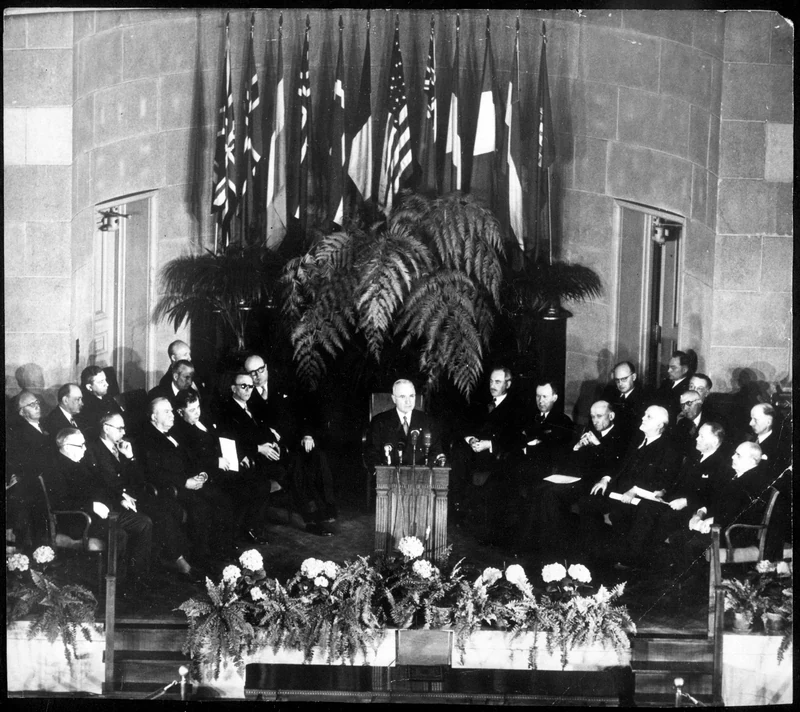
Harry S. Truman speaks at a podium with the foreign ministers of the NATO signatory nations seated behind him.

DOCUMENTARY EVENT PHOTOGRAPH

President Harry S. Truman addresses the North Atlantic Treaty signing ceremony, April 4, 1949, at the State Department Auditorium in Washington, D.C. Archival event photograph; not evidence of later treaty implementation.

Photo source & use notes

Date: Photographed April 4, 1949

Place: State Department Auditorium, Washington, D.C.

New York Times Paris Bureau / Harry S. Truman Presidential Library and Museum, National Archives (306-NT-355C-24) (opens in a new tab)

Public Domain — exact official archival item designation (opens in a new tab)

The archive marks this exact item Public Domain and credits the New York Times Paris Bureau. An individual photographer is not named.

The archive places responsibility for attribution and rights assessment on users. This ceremony photograph does not establish later treaty implementation.

Context & scope

A presidential-era record involving the Senate, Canada, and European founding members; not exclusive presidential causation. Historical alliance established; outcome verification refers to 1949, with institutional context from the March 2019 CRS vintage.
Open the full evidence record

02 / SECOND CASEDonald Trump · Trump II

Panama · security cooperation

2026

Implementation reported · March 17, 2026

Current administration case · reviewed October 5, 2026

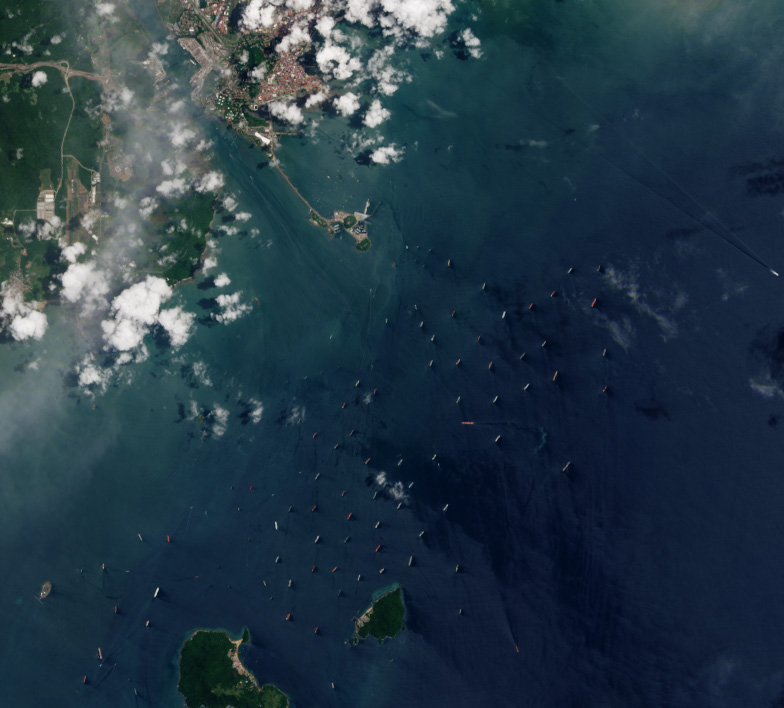
Landsat image of vessels near the Pacific approach to the Panama Canal on August 18, 2023.

DATED ARCHIVAL CONTEXT

Ships near the Pacific approach to the Panama Canal · August 18, 2023. Archival geographic context predating the security-cooperation actions in this record.

Photo source & use notes

Date: Landsat acquisition August 18, 2023 (retained prior verified metadata)

Place: Pacific approach to the Panama Canal, Panama

NASA Earth Observatory / Wanmei Liang, using USGS Landsat data (opens in a new tab)

Retained prior source verification; NASA editorial/informational media-use guidelines (opens in a new tab)

The original article could not be reopened for this review. The acquisition date, place and credit are retained from the previously verified source record.

This August 18, 2023 satellite view is archival geographic context. It does not establish security-cooperation delivery, construction, canal control or policy effects.

NASA’s editorial and informational media-use guidance applies, without implied NASA endorsement.

Context & scope

Defense testimony reports joint security institutions, jungle training and priority, cost-neutral military transit. It does not establish a transfer of canal ownership or universal free commercial passage.

Open the full evidence record

A CHRONOLOGICAL INDEX

Different moments.
A common reading standard.

Selected-case start years, ordered chronologically. Choose a case for the first column; choosing the second case swaps the pair. Shared years are grouped without implying an order within the year.

  1. 1949

  2. 1989

  3. 2022

  4. 2026

Documentary context

HISTORICAL BALANCE OF POWER

The challenge
behind the record.

How strong was the counterpart relative to the United States at the time? These dated official benchmarks add context to the decisions a president faced.

They are selected snapshots, not a full timeline or a presidential score. Economic output, military resource costs and ship counts measure different things. Their ratios cannot rank the overall strength of different rivals.

Sources checked . Observation years and document dates appear separately below.

U.S. = 100 within each measure. Every chart uses the same 0–150 index scale; the index does not make GNP, costs and ships equivalent. Counterpart indexes are rounded. Read the date, measurement basis and limits with each pair.

Timing matters. The 1956 GNP pair uses the same year. The 1975 cost and 2015 fleet pairs have explicitly different fiscal/calendar cutoffs. None is a 2026 power estimate.

These snapshots are not automatically assigned to your selected presidential cases. An unreviewed period is not filled with the nearest available year.

1956Eisenhower presidency · assessed in 1957

Estimated GNP ratio

Economic scale in the early Cold War

Soviet GNP: about 40% of U.S. GNPEstimated GNP ratio · U.S. = 100
United States100 index points; United States equals 100
Soviet Union (USSR)approximately 40 index points; United States equals 100

U.S. window: 1956Counterpart window: 1956

Measurement basisThe November 1957 intelligence estimate compares 1956 GNP ‘in dollar terms.’ This is the source’s approximate ratio, not a new currency conversion.

What this establishes
U.S. intelligence assessed a smaller Soviet economic base. The same 1957 document nevertheless judged then-current Soviet defense expenditures in dollar terms about equal to U.S. expenditures; it did not date that defense claim specifically to 1956.
What it does not establish
GNP is not GDP. The excerpt does not define a modern market-exchange-rate or PPP series. The 1962 figure is a forecast and is excluded. This does not mean the USSR had 40% of U.S. military power.

1975Nixon–Ford U.S. fiscal window · assessed in 1976

Estimated resource cost

Defense programs, priced in the United States

About $114bn versus $80bnEstimated resource cost · U.S. = 100
United States100 index points; United States equals 100
Soviet programs at U.S. pricesapproximately 143 index points; United States equals 100

U.S. window: U.S. fiscal 1975Counterpart window: Soviet calendar 1975

Measurement basisConstant 1974 U.S. prices. CIA estimated the cost of reproducing Soviet programs in the United States, compared with adjusted U.S. authorizations. U.S. fiscal 1975 and Soviet calendar 1975 are different windows.

What this establishes
This measures the scale of military resources at U.S. prices. The ratio is about 1.4 to 1 in this estimate; the source includes comparable account adjustments, rather than an exchange-rate conversion of the Soviet budget.
What it does not establish
Not actual Soviet spending, its economic burden or relative combat effectiveness. U.S. price weights can overstate the Soviet programs’ cost. The fiscal/calendar offset prevents an exact-period comparison. Do not combine this with the 1956 economy estimate into one year’s profile.

2015Obama presidency · reported in the 2024 CRS edition

Battle-force ship count

Fleet size in a defined historical window

China: 255 ships · United States: 271Battle-force ship count · U.S. = 100
United States100 index points; United States equals 100
China (PRC) navyapproximately 94 index points; United States equals 100

U.S. window: U.S. fiscal-year end 2015Counterpart window: PRC calendar-year end 2015

Measurement basisCRS Table 2: Chinese battle-force ships at calendar-year end, U.S. battle-force ships at fiscal-year end. The dates are three months apart. Both totals include auxiliary and support ships; the Chinese total excludes missile-armed coastal patrol craft.

What this establishes
A historical comparison of fleet numbers in the same named year, with different cutoff dates. The chart indexes the reported counts: 255 ÷ 271 × 100 ≈ 94. It does not describe the fleets operating today.
What it does not establish
Ship types, tonnage, weapons, readiness, logistics and regional deployment differ. A count ratio is not a combat-power ratio. Later forecast columns are excluded; this edition supplies no matched contemporary GDP or nuclear-stockpile pair for China.

Read the whole strategic position.

Coverage still matters: these benchmarks do not provide every presidency with matched economic, military and nuclear data. The separate nuclear comparison adds dated U.S.–Soviet and U.S.–China pairs with their own definitions, plus population context. A matched current nuclear pair and comparable China–USSR income series remain unverified.

Compare nuclear counts & population
  1. Nuclear & conventional capabilities

    What forces, readiness and deterrent capabilities existed, and what could each side deploy in the relevant theater?

  2. Alliances & geography

    Which allies, bases, supply routes and geographic constraints shaped the options available to each side?

  3. Freedom & sovereignty

    What happened to national sovereignty, free institutions and individual liberties, and how durable were those outcomes?

How we compare strategic context

FOLLOW THE EVIDENCE

The documents behind the benchmarks.

  1. [1] U.S. intelligence / State Department archiveDocument date: 1957-11-12

    NIE 11–4–57: Main Trends in Soviet Capabilities and Policies, 1957–1962 (opens in a new tab)

    FRUS 1955–1957, Volume XIX, document 161; paragraph 20, printed page 670. The 1956 estimate is distinct from the 1962 forecast.

    Read the source passage

    In dollar terms Soviet GNP would rise from about 40 percent of US GNP in 1956 to about 45 percent in 1962. However, estimated Soviet defense expenditures, in dollar terms, are already about equal to those of the US.

  2. [2] CIA / State Department archiveDocument date: 1976-02

    A Dollar Comparison of Soviet and US Defense Activities 1965–1975 (opens in a new tab)

    SR 76–10053; FRUS document 162, printed pages 733–735. Dollar Cost Comparisons; Total Defense Costs; Figure 1 time-basis note.

    Read the source passage

    At about 114 billion dollars (1974 prices), they are more than 40 percent higher than comparable US authorizations of 80 billion dollars in 1975. […] The US data are in fiscal year terms and the estimated dollar costs of Soviet programs are in calendar year terms.

  3. [3] Congressional Research Service / ONI / U.S. NavyDocument date: 2024-01-30

    China Naval Modernization: Implications for U.S. Navy Capabilities—Background and Issues for Congress (opens in a new tab)

    RL33153, Table 2, printed page 10, 2015 column and source note; comparison cautions on pages 8–9 and Appendix A. Historical China counts from ONI’s February 2020 paper.

    Read the source passage

    Figures are for end of calendar year. Source for figures for U.S. Navy: U.S. Navy data; figures are for end of fiscal year.

  4. [4] Congressional Research Service / 2022 Defense StrategyDocument date: 2024-02-28

    Great Power Competition: Implications for Defense—Issues for Congress (opens in a new tab)

    R43838, printed pages 4–5, quoting the October 2022 National Defense Strategy. A dated administration assessment, not a 2026 threat classification.

    Read the source passage

    Even as we focus on the PRC as our pacing challenge, the NDS also accounts for the acute threat posed by Russia, demonstrated most recently by Russia’s unprovoked further invasion of Ukraine.

THE COMPLETE CASE DIRECTORY

Read each record in full.

All 29 selected cases remain available here, regardless of the comparison controls. Cases are ordered by their historical starting period within each theme.

Liberal democracy & human rights

  1. Clinton · 1994–1996Haiti: restoration of elected government and election supportHistorical snapshot · reviewed October 6, 2026
  2. George W. Bush · 2004–2006Security assistance: human-rights screening reforms and oversight gapsHistorical snapshot · reviewed October 6, 2026
  3. Obama · 2014–2016 · 2017 follow-upCuba: diplomatic normalization with unresolved human-rights limitsHistorical snapshot · reviewed October 6, 2026
  4. Trump II · 2026Cuba · repression and sanctionsCurrent administration case · reviewed October 5, 2026
  5. Trump II · 2026Venezuela · transition measuresCurrent administration case · reviewed October 5, 2026

Rule of law & transnational crime

  1. Nixon · 1970–1973Controlled Substances Act and DEA reorganization: legal action, unverified social resultsHistorical snapshot · reviewed October 6, 2026
  2. George W. Bush · 2000–2008 · inherited programPlan Colombia: security gains and unmet drug-reduction goalsHistorical snapshot · reviewed October 6, 2026
  3. Obama · 2009–2010 · inherited programMérida: inherited cooperation, rule-of-law revision and incomplete outcome measuresHistorical snapshot · reviewed October 6, 2026
  4. Trump II · 2025–2026Drug & cartel enforcementCurrent administration case · reviewed October 5, 2026
  5. Trump II · 2026Shield of the AmericasCurrent administration case · reviewed October 5, 2026

Alliances & security cooperation

  1. Truman · 1949Creation of NATOHistorical snapshot · reviewed October 6, 2026
  2. George H. W. Bush · 1989–1990Diplomacy supporting German reunificationHistorical snapshot · reviewed October 13, 2026
  3. Biden · 2022–2024NATO accession of Finland and SwedenHistorical snapshot · reviewed October 6, 2026
  4. Trump II · 2026Greenland · Arctic defenseCurrent administration case · reviewed October 5, 2026
  5. Trump II · 2026Panama · security cooperationCurrent administration case · reviewed October 5, 2026

Peace & conflict

  1. Eisenhower · 1953–1954Korean armistice and U.S.–ROK treatyHistorical snapshot · reviewed October 6, 2026
  2. Kennedy · October–November 1962; Turkey missile withdrawal in April 1963Cuban Missile Crisis: missile withdrawal and negotiated de-escalationHistorical snapshot · reviewed October 13, 2026
  3. Nixon · 1972–1977; ABM withdrawal in 2002SALT I and the ABM TreatyHistorical snapshot · reviewed October 6, 2026
  4. Carter · 1979; durability observed through July 2022 sourceSupport for Egypt–Israel peaceHistorical snapshot · reviewed October 6, 2026
  5. Reagan · 1987–1991; treaty lapse in 2019INF missile-elimination treatyHistorical snapshot · reviewed October 6, 2026
  6. Reagan · 1987–1988Persian Gulf protection operations against Iranian military assetsHistorical snapshot · reviewed October 6, 2026
  7. George H. W. Bush · 1990–1991; contemporary outcome confirmation in July 1991Gulf War coalition and the liberation of KuwaitHistorical snapshot · reviewed October 13, 2026
  8. Clinton · 1995; political limits observed in April 2019 sourceDayton peace agreementHistorical snapshot · reviewed October 6, 2026
  9. George W. Bush · 2007–2008 · dated oversightIraq: 2007–2008 security gains, incomplete institutions and persistent costsHistorical snapshot · reviewed October 6, 2026
  10. Obama · 2015–2016; U.S. withdrawal in 2018Iran nuclear agreement implementationHistorical snapshot · reviewed October 6, 2026
  11. Trump I · 2020; implementation observed January 2021Israel–UAE and Bahrain normalizationHistorical snapshot · reviewed October 6, 2026
  12. Trump II · June 2025 · later assessment in 2026Iran nuclear-site strikes and subsequent assessmentHistorical snapshot · reviewed October 6, 2026
  13. Trump II · 2026Gaza · phase-two arrangementsCurrent administration case · reviewed October 5, 2026
  14. Trump II · 2026Iran · agreements and renewed conflictCurrent administration case · reviewed October 5, 2026